The Game
Shattered Lands draws from the golden age of MMOs: EverQuest's danger, Star Wars Galaxies' crafting, EVE's connected economy, Ultima's consequences. One world. No compromises.
The World
You wake up on a fragment of rock drifting through an endless void. The sky is wrong. The ground ends abruptly at the edges. Somewhere nearby, other survivors are trying to figure out the same thing you are: what happened?
Something shattered reality. Not a war, not an apocalypse, but something stranger. The world broke apart into fragments, and those fragments are all that's left. Pieces of kingdoms, slices of forests, chunks of cities from places and times that shouldn't exist together, all drifting in a void that isn't empty so much as it is absent.
Nobody remembers the Shattering itself. The survivors, you among them, just woke up here, on whatever fragment caught you. Maybe you were a soldier. Maybe a blacksmith. Maybe something stranger. What you were before shapes how you start, but where you go from here is up to you.
The fragments aren't alone. They're connected by nodes, thin and fragile bridges through the void that link the regions you can reach. Travel between fragments is possible, but it's never trivial. The distance between two nodes might be a short walk or a dangerous expedition through hostile territory, and what you find on the other side is never guaranteed. And the map is built to keep growing, as new fragments surface from the void.
Some fragments have been settled. Towns built, guards posted, trade routes established. Others are wilderness: dangerous, resource-rich, claimed by creatures or by players willing to fight for them. And at the far edges, where the void presses close, there are fragments that drift in and out of existence entirely. The most valuable resources come from these places. So do the most permanent consequences.
Death here costs you something. Not permanence, because a bindstone catches your soul when you fall, so death sends you back, not away. But you leave your body behind, and everything on it. In the settled places, your corpse is protected. In the frontier, it's not. And on an ephemeral fragment? If the fragment drifts away before you get back, your gear goes with it.
The world doesn't explain itself to you. You explore. You ask other players. You piece together what happened from fragments of lore, ruins that don't make sense, and the slowly dawning realization that the Shattering might not be over.
How It Plays Today
These systems are built and working in the current alpha. See the roadmap for what's coming next.
Combat
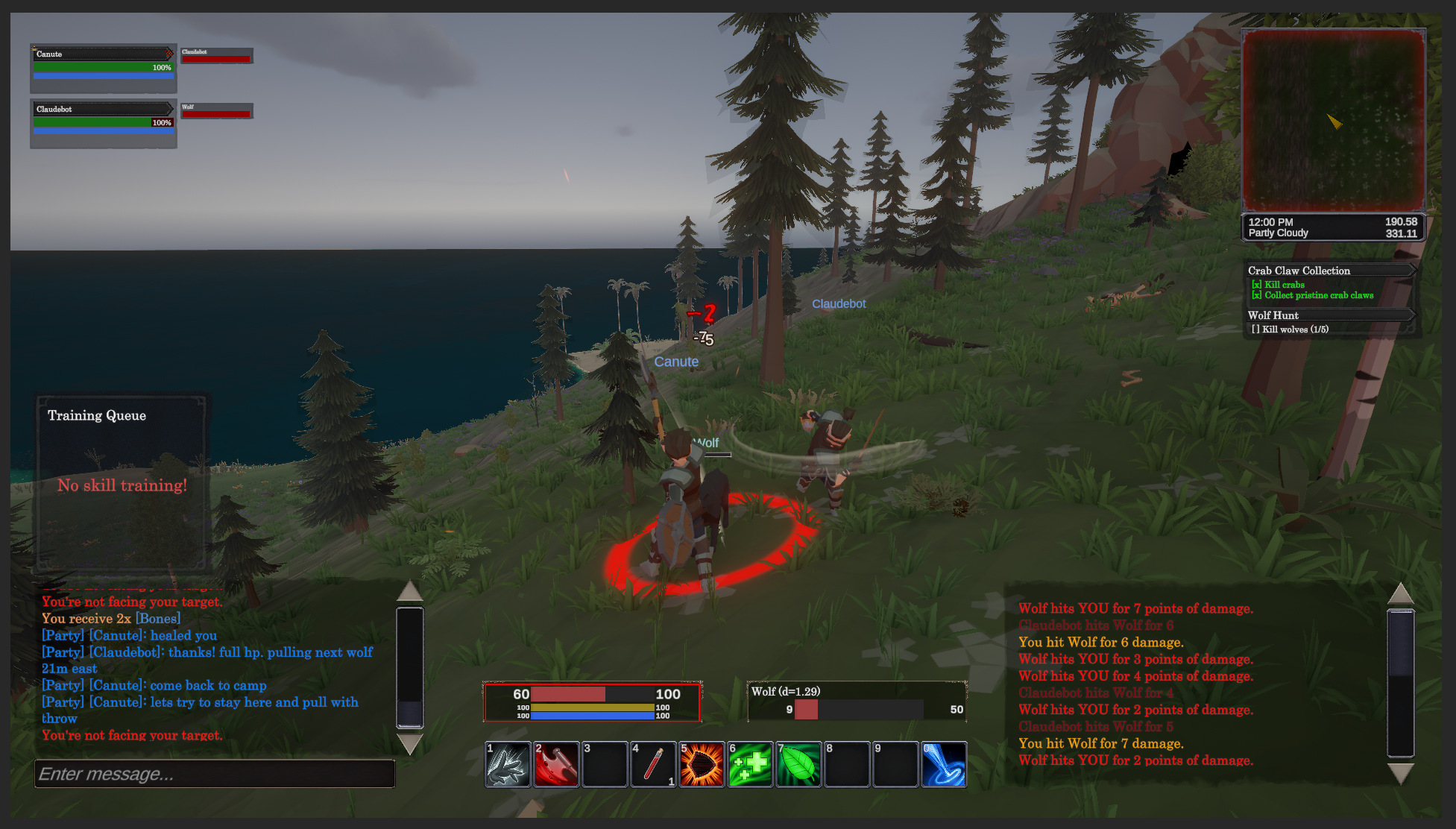
Tab-target with auto-attack and abilities. Dodge, parry, block. Dual wielding, two-handers, ranged weapons, and summoned familiars. Tanks hold attention with taunts and shouts, healers and support casters keep the party standing, and enemy casters telegraph their big hits with a marked circle you have seconds to escape. Nameplates show a difficulty rank so you can judge a fight before you pick it. Sprint to close the gap or escape it, at a stamina cost.
Progression
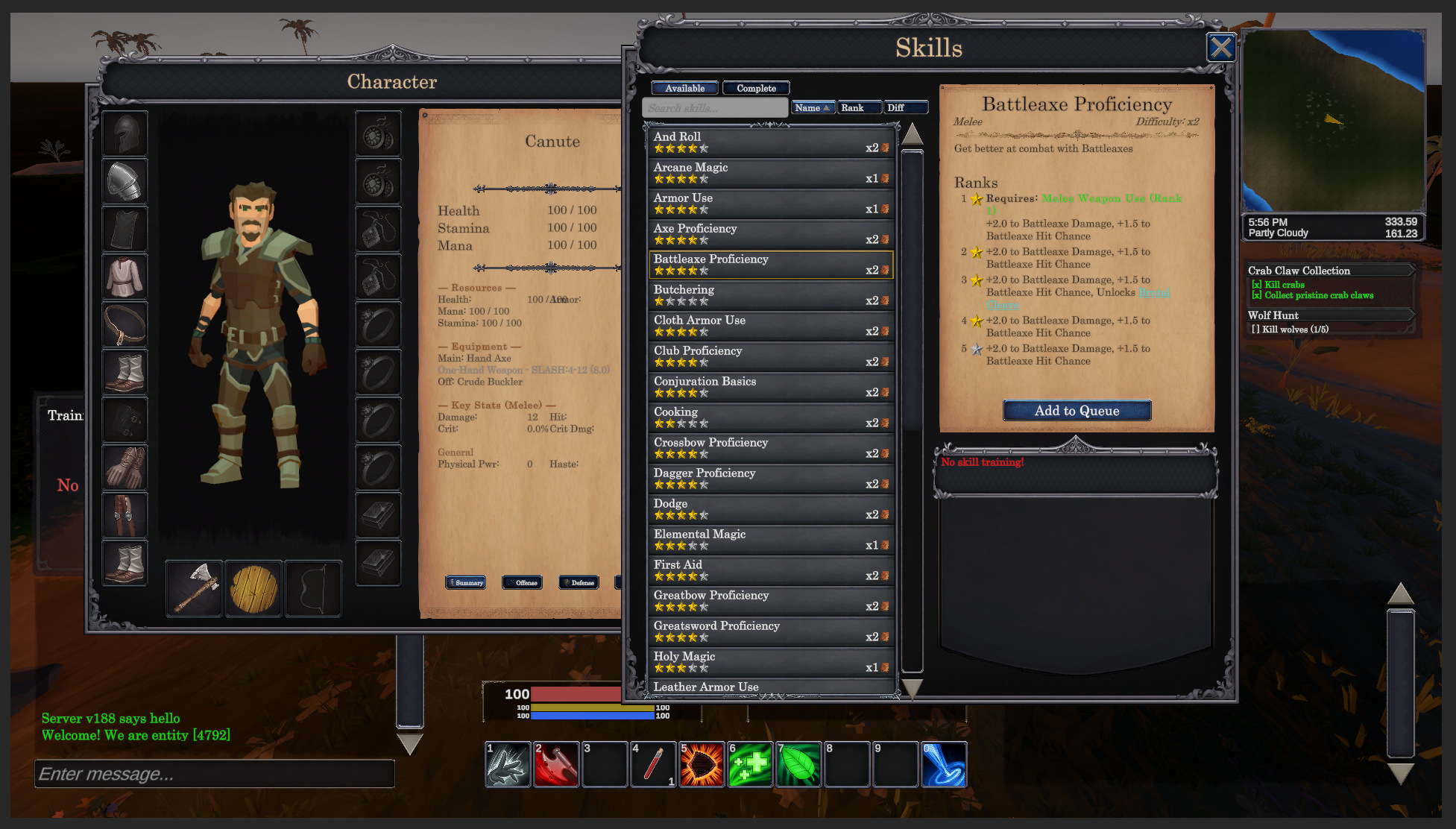
Mastery is earned by doing: every skill grows by using it, and you spend the points you earn to rank up the path you choose. You can train broadly, but you equip one loadout at a time, so no one is everything at once: the deeper you commit, the more others rely on you for it.
Death & Consequences
Die and your corpse stays where you fell, with your gear on it. Vitae penalty weakens you until you recover. Loot your own body and your gear goes straight back on. Corpse dragging for friends who don't make it back.
Quests & NPCs
A starter arc that branches by playstyle (fighter, crafter, or gatherer), then multi-part quest lines that take you across the map: kill, collection, and delivery objectives, named-monster hunts, and repeatables. Crafting and gathering count toward objectives too. Guards and dungeon wardens walk patrol routes, monsters call their friends to arms, and camps hold rare named spawns worth camping.
Crafting
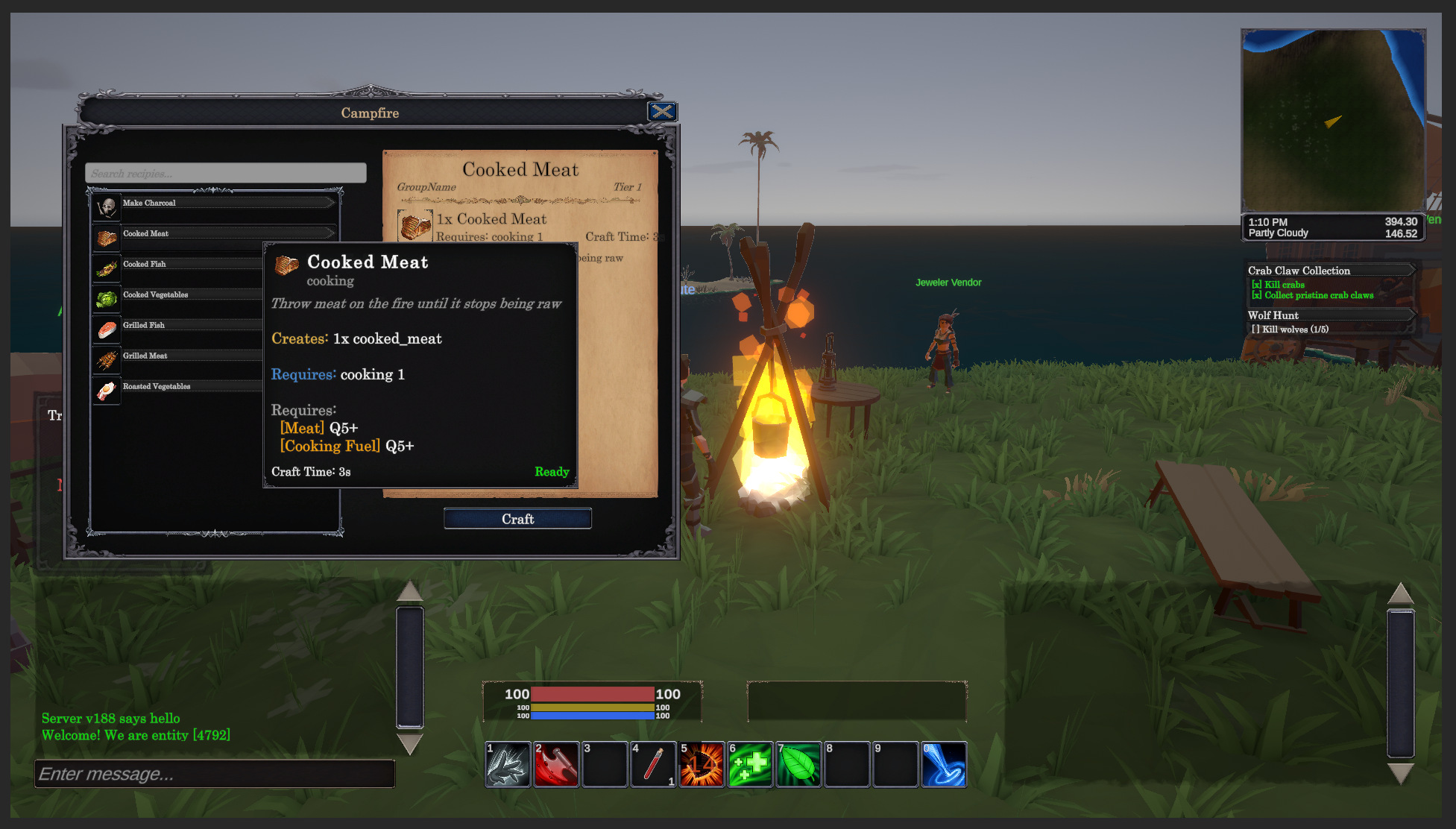
Walk up to a forge, alchemy table, loom, or campfire and craft. Stations show visual effects while you work. Material quality flows through every step, ore to ingot to blade to sword, and your name and the materials' history travel with the finished item. Some goods take more than one trade to make: a Field Repair Kit needs oil from an alchemist, patches from a leatherworker, cloth from a weaver, and rivets from a smelter before anyone can assemble it.
Gathering
Two ways to find resources. See it, gather it: herbs, mushrooms, and trees grow visibly, so equip the right tool and harvest. Or prospect for what's hidden: scan a hillside for ore, read the water for fishing spots. Different biomes grow different things, and the best materials hide in the most dangerous places.
Social
Party formation, friends and block lists, and chat that spans the world: local, party, and whisper plus Global and Trade channels. /who shows everyone online, party invites work by name from anywhere, and /follow keeps you with your group on the road. Faction standing is tracked and persists.
Economy & Vendors
Merchants buy and sell, with a buyback tab for seller's remorse. Direct player-to-player trading with lock and confirmation. Bank storage you can organize. Every item has weight and packs have limits, so what you haul is a decision: gatherer garments trade armor for carrying more of your material.
The World
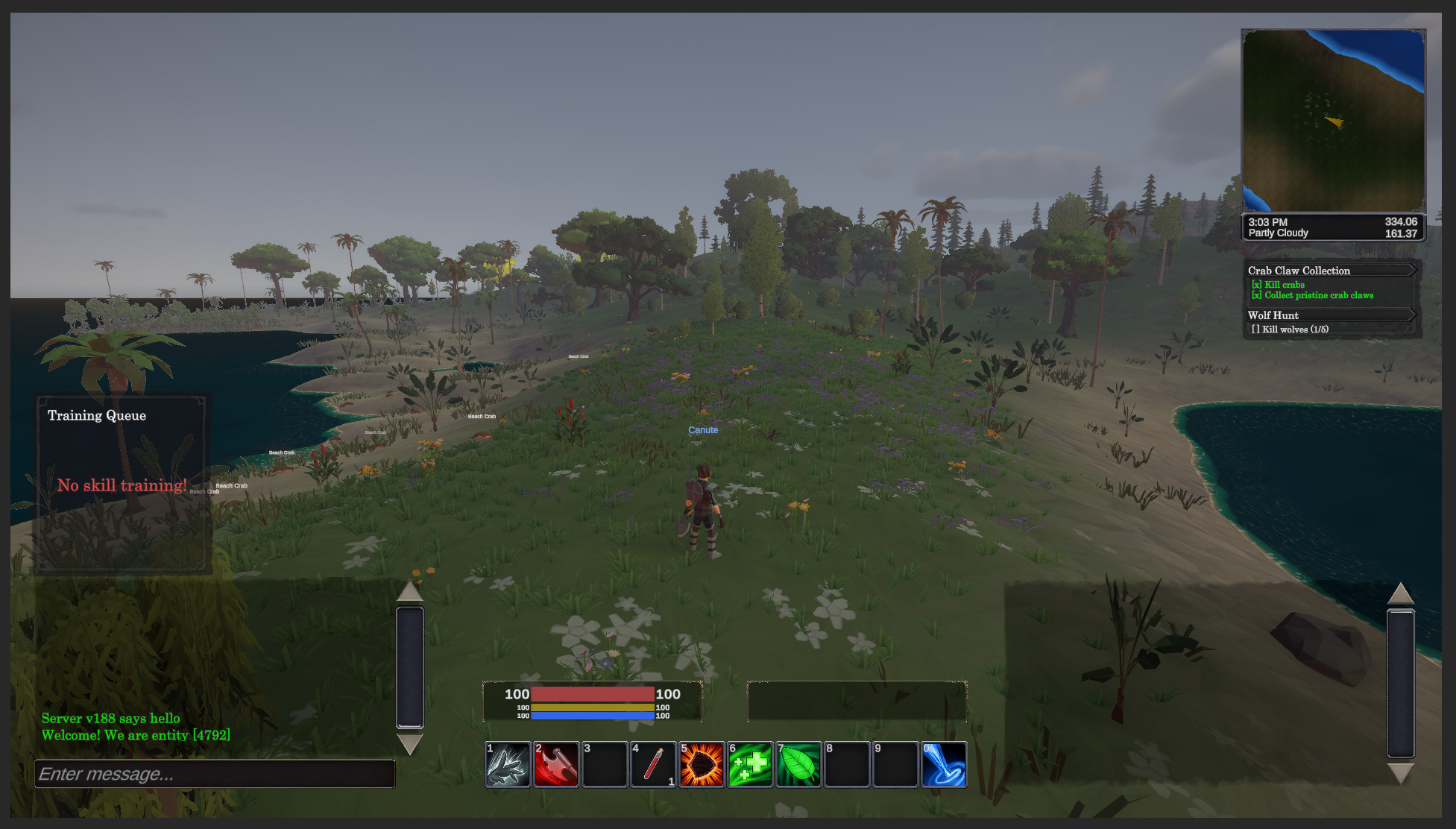
One full coastal region to explore today, linked by walk-through vortex portals and dotted with interiors, including a multi-level dungeon with a boss at the bottom, and more of the multiverse built to grow from here. A day and night cycle that keeps the server's clock. A world that feels like a place, not a menu.
What Makes It Different
- • Built by one person with AI collaborators, not a 200-person studio with a marketing department
- • Every playstyle is a profession: your starting class gives you a foundation, but what you become is up to you
- • No daily login tricks, no battle passes, no FOMO mechanics: the game respects your time
- • Consequences: the game trusts you with the stakes and rewards you for it
On the Shoulders of Giants
Shattered Lands isn't a clone of any one game. It's a synthesis: the best ideas from the golden age of MMOs, unified in one world.
EverQuest
1999Danger, community, and the audacity to go anywhere. EQ didn't just make a fantasy world. It went to the moon, opened the Planes of Power, and threw you at Quarm. The world felt massive and dangerous. Running through Kithicor at night was a story you told for years. That sense of weight, consequence, and sheer ambition is the foundation of everything we're building.
Star Wars Galaxies
2003The gold standard for crafting and gathering. Resources had quality attributes that changed what you could make. Master crafters were famous across servers, sought out by name. Harvesters dotted the landscape. Player cities grew organically. SWG proved that non-combat gameplay could be just as deep, prestigious, and community-defining as any raid.
EVE Online
2003Progression that respects your life. Security zones that let you choose your risk. But EVE's deepest inspiration for us is the network: systems connected by gates, each with different resources, different sovereignty, different politics. Now imagine that played out across shattered nodes that are fragments of different realities and timelines. Player-owned zones with exotic resources, contested connections, alliances and betrayals over territory worth holding. EVE's space politics, but the nodes are fantasy realms, sci-fi ruins, and places that shouldn't exist.
Ultima Online
1997The original player-driven world. Your reputation was your currency, earned through actions, not achievements. Players built the economy themselves, top to bottom. Consequences gave everything meaning. UO proved that when you trust players with a living world, they'll build something no developer could script.
Asheron's Call
1999The willingness to experiment when everyone else played it safe. Monthly events that permanently changed the world. The vitae penalty: death that made you think without making you quit. AC proved that an MMO could evolve, surprise its players, and treat its world as a living thing rather than a static theme park.
Horizons (Istaria)
2003Player-built structures that weren't just decoration. They were infrastructure. Bridges, buildings, entire communities constructed cooperatively. The idea that players don't just inhabit a world, they physically build it. That's the vision for player structures on claimed nodes.
If you remember these games fondly, the communities, the danger, the triumphs...
We're building Shattered Lands for you.